
Using the Bush Winch for Vehicle Recovery
 A Practical Guide to Getting Unstuck
When your vehicle gets stuck in sand, mud, or ice, the sinking feeling of being stranded can be overwhelming. Whether you’re an off-road enthusiast tackling rugged trails or an everyday driver caught in unexpected conditions, having a reliable recovery solution is great peace of mind.
Enter the Bush Winch, a unique, portable and innovative vehicle recovery system designed to help you free yourself and get back on track without the need for heavy, complex equipment. In this short article, we’ll explore how the Bush Winch works, its advantages and practical steps for using it.
What is the Bush Winch?
The Bush Winch is a lightweight, wheel-mounted winching system that leverages your vehicle’s own engine power to pull it out of sticky situations.
Unlike traditional electric or hydraulic winches that require permanent installation and complex wiring, the Bush Winch attaches directly to your vehicle’s wheels, using specially designed wheel nuts or bolts that are permanently in place so it can be attached easily at any time.
This system, developed by Western Australian geologist Patrick Verbeek over more than a decade, is engineered for simplicity, durability, and versatility. It’s suitable for a wide range of vehicles, including 2WD, 4WD, and AWD models, making it a practical choice for both off-road adventurers and casual drivers.
Weighing approximately 10kg (22lbs) and packing into a portable carry bag, the Bush Winch is easy to store and transport. Its core components include two wheel-mounted winch drums, high-strength Dyneema SK75 winch ropes, custom wheel nuts or bolts, rope guides and an optional anchor kit.
The system’s design eliminates the need for vehicle modifications, and its high-specification components are built to withstand tough conditions without mechanical or electrical failures.
How Does the Bush Winch Work?
The Bush Winch operates by harnessing the vehicle’s engine power to wind a strong, lightweight rope onto drums attached to the wheels. These drums are secured using custom wheel nuts or bolts, which replace the vehicle’s original ones and remain in place even when the winch is not in use.
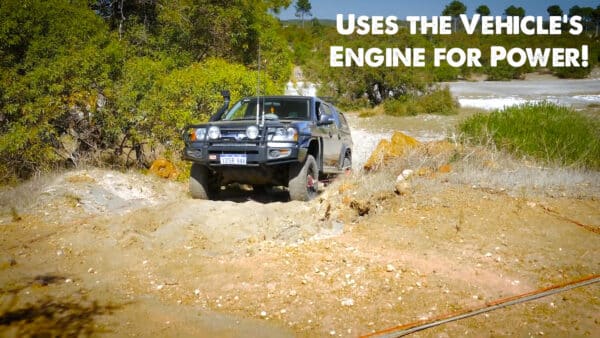 The rope is anchored to a fixed point—such as a tree, rock, or one of Bush Winch’s portable anchor kits and, as the vehicle’s wheels turn, the rope spools onto the drums, pulling the vehicle toward the anchor point either forwards or backwards, depending on the best solution to the situation.
Rope guides, which clip onto the wheels, ensure the rope feeds smoothly onto the drum, even when winching at an angle. This is particularly useful when anchor points are not directly aligned with the vehicle’s path.
The Bush Winch’s ability to use the vehicle’s “unlimited” engine power provides significant pulling force, limited only by the engine’s capacity and the strength of the anchor point.
Advantages of the Bush Winch
The Bush Winch offers several advantages over traditional winches, making it an appealing option for vehicle recovery:
- Portability and Simplicity: At just 10 kg, the Bush Winch is far lighter than traditional bumper-mounted winches, which can weigh significantly more and require permanent installation. Its compact design makes it easy to store in a vehicle’s trunk or cargo area, ideal for those who don’t want a fixed winch taking up space.
- No Vehicle Modifications: Unlike electric winches that require mounting brackets, wiring, and sometimes a winch bar, the Bush Winch requires no alterations to your vehicle. The custom wheel nuts or bolts are designed to match your vehicle’s specifications, ensuring a secure fit without compromising safety.
- Versatility: The system is compatible with a wide range of vehicles, including those with manual or automatic transmissions, front- or rear-wheel drive, and even vehicles without differential locks or traction control. This makes it a practical solution for everything from lightweight 2WD cars to heavy-duty 4WDs.
- Durability: The Bush Winch Series II, released in 2018, uses advanced materials like long glass fiber bonded with industrial-grade nylon polymer, commonly found in defense and automotive applications. The Dyneema SK75 ropes are lightweight, strong (with a breaking strain of up to 3 tonnes for a 5mm rope) and low-recoil, reducing the risk of injury if a rope breaks.
- Cost-Effectiveness: The Bush Winch is often more affordable than high-end electric winches, which can cost upwards of $1,000 when factoring in installation. Its lifelong design and lack of maintenance requirements, further enhance its value.
- Anchor Flexibility: The Bush Winch can be paired with natural anchor points (like trees or rocks) or portable anchor kits, such as the Sand Anchor Kit or Ground Anchor Kit. These kits include augers and spades that screw into the ground, providing a stable anchor point in environments where natural options are scarce.
Using the Bush Winch for Vehicle Recovery
Using the Bush Winch for vehicle recovery is straightforward, but it requires careful setup to ensure safety and effectiveness. Here’s a step-by-step guide based on the information provided on the Bush Winch website: www.bushwinch.com
- Assess the Situation: Before setting up the winch, evaluate the terrain and identify a suitable anchor point. If no natural anchors (eg. trees or rocks) are available, use a Bush Winch anchor kit. Ensure bystanders are clear of the recovery area to avoid injury.
- Install the Custom Wheel Nuts/Bolts: If not already installed, replace your vehicle’s standard wheel nuts or bolts with the custom ones provided in the Bush Winch Kit. These have slots to secure the winch drums and are designed to match your vehicle’s bolt pattern and thread type. This step is typically done in advance to save time during recovery.
- Attach the Winch Drums: Secure the winch drums to the wheel hubs of two opposite-side wheels (usually the rear axle for forward recovery). Ensure the drums are firmly attached to the slotted wheel nuts or bolts.
- Set Up the Anchor Point: If using a natural anchor, loop the winch rope around it securely. For portable anchors, screw the auger and spade into the ground to create a stable anchor point. For added strength, use two anchors in tandem to share the load, as you will find in one of the Bush Winch Anchor Kits.
- Attach the Winch Rope: Connect the Dyneema SK75 rope to the anchor point and feed it through the rope guides (if winching at an angle) to the winch drums. Ensure the rope is taut and properly aligned.
- Engage the Vehicle: With the vehicle in gear (forward or reverse, depending on the recovery direction), gently apply throttle to begin winching. The wheels will rotate, spooling the rope onto the drums and pulling the vehicle toward the anchor point. Winch slowly and stop periodically to check progress and ensure the setup remains secure.
Once the vehicle is on firm ground, stop winching and remove the drums. You’re then able to take to the track or road again.
Using Bush Winch in the Real World
The Bush Winch has been praised for its effectiveness in various scenarios. For example, Austrack 4WD Training reported that the Bush Winch effortlessly pulled a vehicle out of a bog and up a dune, even with inflated tires to make the recovery more challenging.
Western 4W Driver Magazine noted that the vehicle “walks itself up a soft sand dune” with minimal stress on the system, and the anchors held firm. These testimonials highlight the system’s reliability in sand, mud, and other challenging terrains, making it a valuable tool for off-roaders and remote travellers.
Conclusion
The Bush Winch offers a practical, portable, and versatile solution for vehicle recovery, leveraging your vehicle’s own engine power to get you unstuck without the need for complex modifications. Its lightweight design, compatibility with various vehicles and robust construction make it an excellent choice for both off-road enthusiasts and everyday drivers.
By following the proper setup steps and safety guidelines, you can use the Bush Winch to confidently tackle sand, mud, ice, or other obstacles. For more details or to find the right kit for your vehicle, visit www.bushwinch.com and use their vehicle selector tool to ensure a perfect fit.
With the Bush Winch in your recovery arsenal, you’ll be better prepared to handle whatever the road (or lack thereof) throws your way.